
Laboratory testing of hardened concrete
MATTEST determines strength and other properties of hardened concrete in control specimens, existing structures, and precast reinforced concrete elements.
We perform laboratory and on-site testing for acceptance of concrete works, incoming and process control, structural inspection, and independent verification of contractor results.
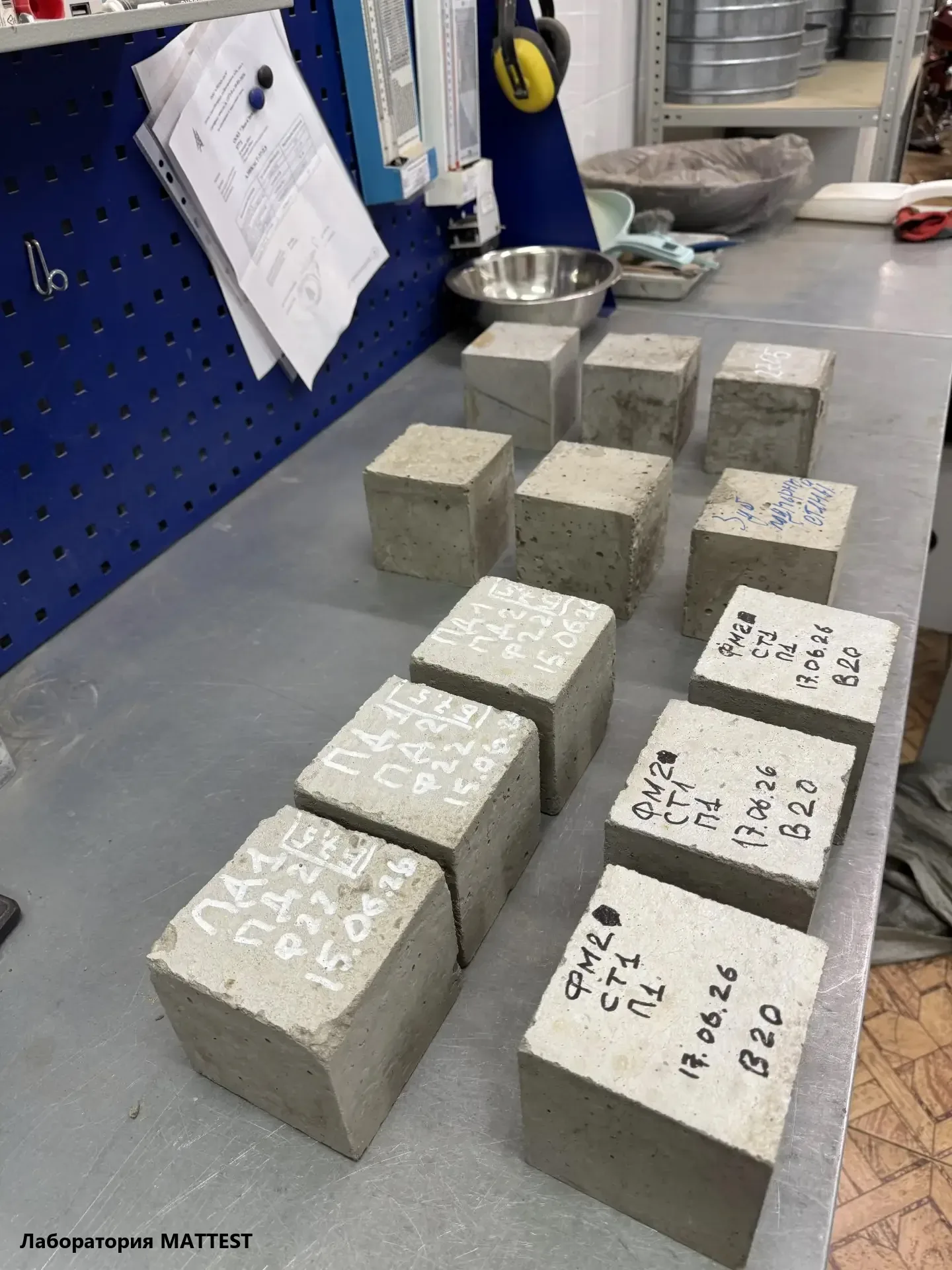
What MATTEST determines in hardened concrete
- 01Compressive strength of concrete specimens
- 02Sampling and testing of concrete cores from structures
- 03Concrete strength by pull-off (pull-out) testing
- 04Non-destructive rapid concrete strength control
- 05Flexural tensile strength
- 06Splitting tensile strength
- 07Average density
- 08Water absorption
- 09Water permeability
- 10Frost resistance
- 11Abrasion resistance
- 12Geometric parameters of precast elements
- 13Concrete cover thickness
- 14Reinforcement location
- 15Ultrasonic homogeneity and internal defect inspection
The specific program depends on the structure, project requirements and client task.
What can be tested
- concrete cubes, cylinders and beams
- specimens cast at the construction site
- cores drilled from existing structures
- cast-in-place walls, columns, slabs and foundations
- concrete floors and pavements
- precast concrete and reinforced concrete elements
- in-service structures of buildings and facilities
Typical client objectives
- determine concrete strength at design or intermediate age
- verify the quality of completed concreting
- confirm that construction can proceed to the next stage
- re-check concrete after an unsatisfactory result of control specimens
- determine actual in-situ strength
- assess concrete homogeneity
- investigate a suspect area
- obtain independent results in a dispute with a contractor or supplier
- gather data for structural survey or engineering decision
Main methods of strength control
Testing of control specimens
Cubes or cylinders are failed in a testing press. The method determines the strength of the produced specimens and applies to batch control provided that sampling, casting, curing and transport were correct.
Coring and testing of drilled cores
Cylindrical cores are drilled from the existing structure. After preparation they are tested in compression in the laboratory. The method evaluates the concrete actually present in the structure.
Pull-off (pull-out) testing
An anchor is installed into the concrete, and the local rupture force is measured. This is a direct mechanical method for controlling in-situ concrete strength.
Rebound (impact-impulse) method
The instrument records the elastic rebound characteristic from the concrete surface. Convenient for rapid control of many areas, but requires a valid calibration correlation.
Ultrasonic method
The passage of an ultrasonic pulse through concrete is measured. Used to assess homogeneity, locate zones of differing properties and to estimate strength when a justified calibration correlation is available.
How to choose a method
Properly produced control specimens are available: we test them in compression.
In-situ concrete strength is required: we apply cores or pull-off testing.
Rapid inspection of a large area or many structures is needed: rebound or ultrasonic methods, anchored by direct tests.
A dispute arose or methods give inconsistent results: the program is built around direct methods, while indirect methods estimate strength distribution across the project.
There is no universally best method. Control cubes characterise the produced specimens, cores characterise concrete at the point of extraction, and indirect methods rapidly cover many areas.
A MATTEST rule of practice
Concrete class is not determined by a single random hammer strike.
Indirect methods depend on the mix, age, moisture and surface state of the concrete. A reliable estimate requires a calibration correlation tied to direct tests of the concrete on this project or a comparable batch.
How the work is performed
- We review the project and the control task.
- We clarify the structure, concrete age and casting history.
- We select the method or a combination of methods.
- We identify the location of control points.
- We perform testing in the laboratory or on site.
- We process the results and compare them with project requirements.
- We issue the test report or a technical conclusion.
Deliverables for the client
- results for each specimen or control point
- layout of control points
- method and equipment used
- photographs of the tests
- actual strength values and other measured properties
- homogeneity assessment when included in the program
- comparison with project requirements
- test report or technical conclusion
Applicable standards
- GOST 10180-2012 — testing of concrete control specimens
- GOST 18105-2018 — rules for concrete strength control and evaluation
- GOST 28570-2019 — strength from cores drilled from structures
- GOST 22690-2015 — mechanical non-destructive methods, including rebound and pull-off
- GOST 17624-2021 — ultrasonic strength control
- GOST 12730.1-2020 — average density
- GOST 12730.5-2018 — water permeability
- GOST 10060-2012 — frost resistance
- ISO 1920, EN 12390 series and ASTM C39 / C42 / C900 — international counterparts applied at project request